ΕΥΧΑΡΙΣΤΙΑΙ · With Gratitude
Credits & Acknowledgements
1204: Shards of Rhomania
Created by
Matthew Riley
Design, writing, code direction, historical research, and a fierce love of the Roman world that wouldn’t lie down.
Built with
Lovable
This game and chronicle were built end-to-end on Lovable. All thanks and proper credit to Lovable and its copyright holders for the platform that made this project possible.
Music & Sound
Pond5 & AudioJungle
All music cues and sound effects are licensed from Pond5 and AudioJungle. Per-asset artist credits are honoured under their original licence terms.
ΕΞΑΙΡΕΤΟΣ ΧΑΡΙΣ · With Special Gratitude
Anna Komnene & The Alexiad
☧ 1083 — c. 1153 · Porphyrogennete · Historian of the Romans
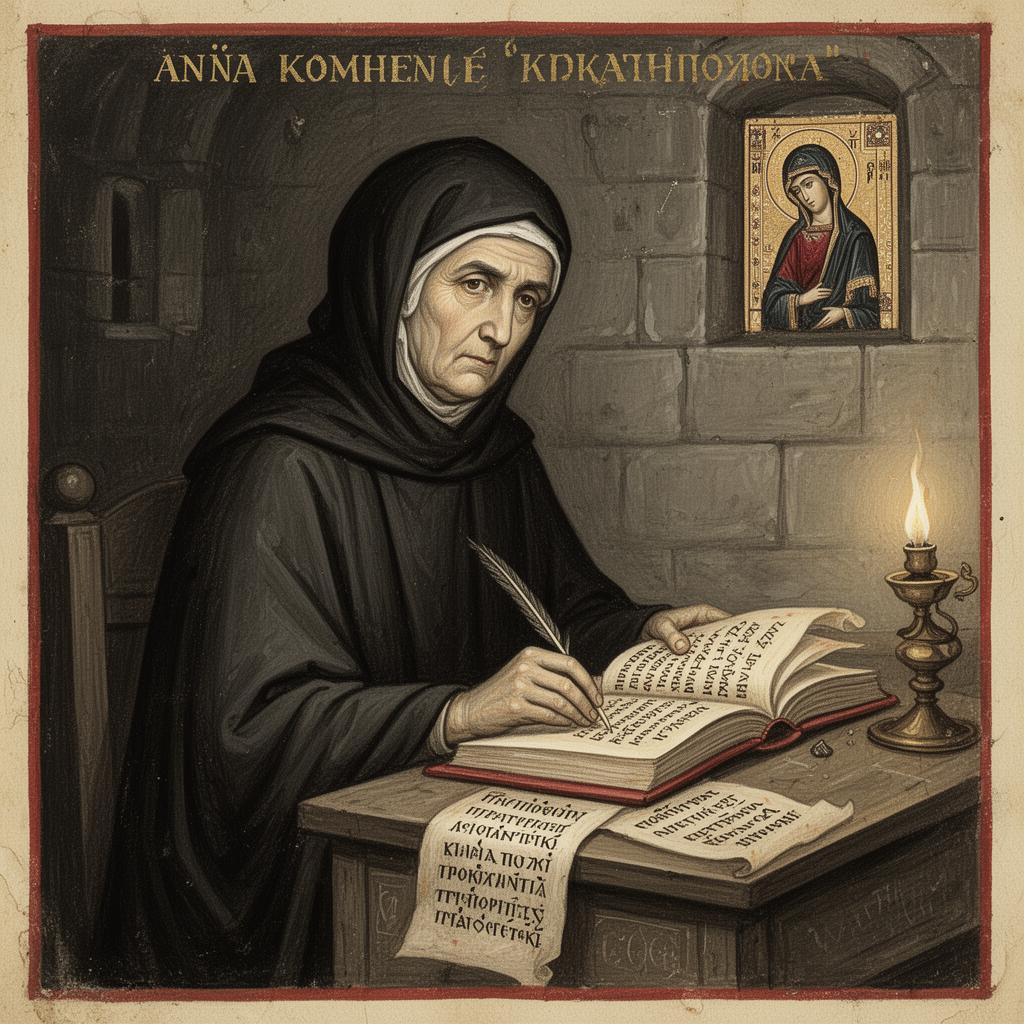
To the porphyrogennete princess who, in her widowhood at the Kecharitomene convent on the western slope of the Fourth Hill, set down the life of her father Alexios in fifteen books of high Atticising Greek — and to the eleven- or twelve-year-old who found her Alexiad on the Penguin Classics shelf at WH Smiths, spending pocket money and Newsroundearnings to buy and devour every volume one by one. It was The Alexiadthat challenged everything he thought he knew, and lit a fire that has been burning for more than forty-five years since.
The Alexiad is the only full-length narrative history we possess from a Byzantine woman, and one of the very few book-length histories written by any woman anywhere in the medieval world. It is the eastern witness to the First Crusade — the only contemporary account from inside the walls — and it remains, nine hundred years on, the indispensable source for the reign of Alexios I Komnenos and the long Roman recovery from Manzikert. Her sketches of Bohemond, Robert Guiscard, and the Pecheneg disaster at Lebounion shape every modern account of the period.
Modern scholarship — Jonathan Shepard, Paul Magdalino, Peter Frankopan, and above all Leonora Neville’s Anna Komnene: The Life and Work of a Medieval Historian (Oxford, 2016) — has restored her as a serious classical scholar at the centre of a Komnenian learned circle, patron of the Aristotelian commentator Michael of Ephesos. She matters to the world both as a foundational source for the late eleventh century and as one of the founding documents of women’s intellectual history: the working proof that a learned woman in the medieval Mediterranean could write a major work of political history in the highest register her culture knew, and have it survive.
This game is, in a quiet way, a long letter of thanks to her. The door she held open is the door I walked through. Αἰωνία ἡ μνήμη.
Podcasts that kept the lamp lit
Byzantium, in the ear
Two podcasts shaped my thinking throughout the writing of this game and deserve loud, public thanks:
- · Byzantium & Friends — Dr Anthony Kaldellis. For insisting, episode after episode, that the Romans of the medieval east were Romans, and for refusing every lazy shorthand. A great deal of this game’s tone — its vocabulary, its self-understanding, its quiet refusal of the word “Byzantine” in-fiction — is owed to him.
- · The History of Byzantium — Robin Pierson. For the patient, year-by-year narrative spine that made the whole shape of the empire legible, and for treating 1204 as the hinge it actually was.
ΕΙΣ ΜΝΗΜΗΝ · In Memoriam
Mike Singleton
1951 — 2012 · Creator of Lords of Midnight
“In the lands of Midnight there walked a Lord whose dominion was the imagination of a generation.”
Creator of Lords of Midnight (1984) — a game that proved a home computer could hold an entire mythic kingdom in 48 kilobytes, and that strategy and storytelling were always one and the same craft. The bones of this chronicle are his. May his memory be eternal.
Historical Sources
Inspirations, not citations
The events of 1204 are drawn from contemporary chronicles and modern scholarship. Any errors or dramatic liberties are entirely the author’s.
- · Anna Komnene — The Alexiad (tr. Frankopan, Penguin Classics)
- · Niketas Choniates — Historia (Annals)
- · Geoffrey of Villehardouin — La Conquête de Constantinople
- · Robert of Clari — La Conquête de Constantinople
- · Leonora Neville — Anna Komnene: The Life and Work of a Medieval Historian
- · Donald M. Nicol — The Last Centuries of Byzantium
- · Michael Angold — The Fourth Crusade: Event and Context
- · Thomas F. Madden — work on the Fourth Crusade and Enrico Dandolo
- · Paul Magdalino — The Empire of Manuel I Komnenos
- · Anthony Kaldellis — The New Roman Empire