ΕΡΓΑΣΤΗΡΙΟΝ · From the Workshop
Anna Komnene, and the Door She Held Open
2 June 2026 AD · Year 7534 of the Roman World
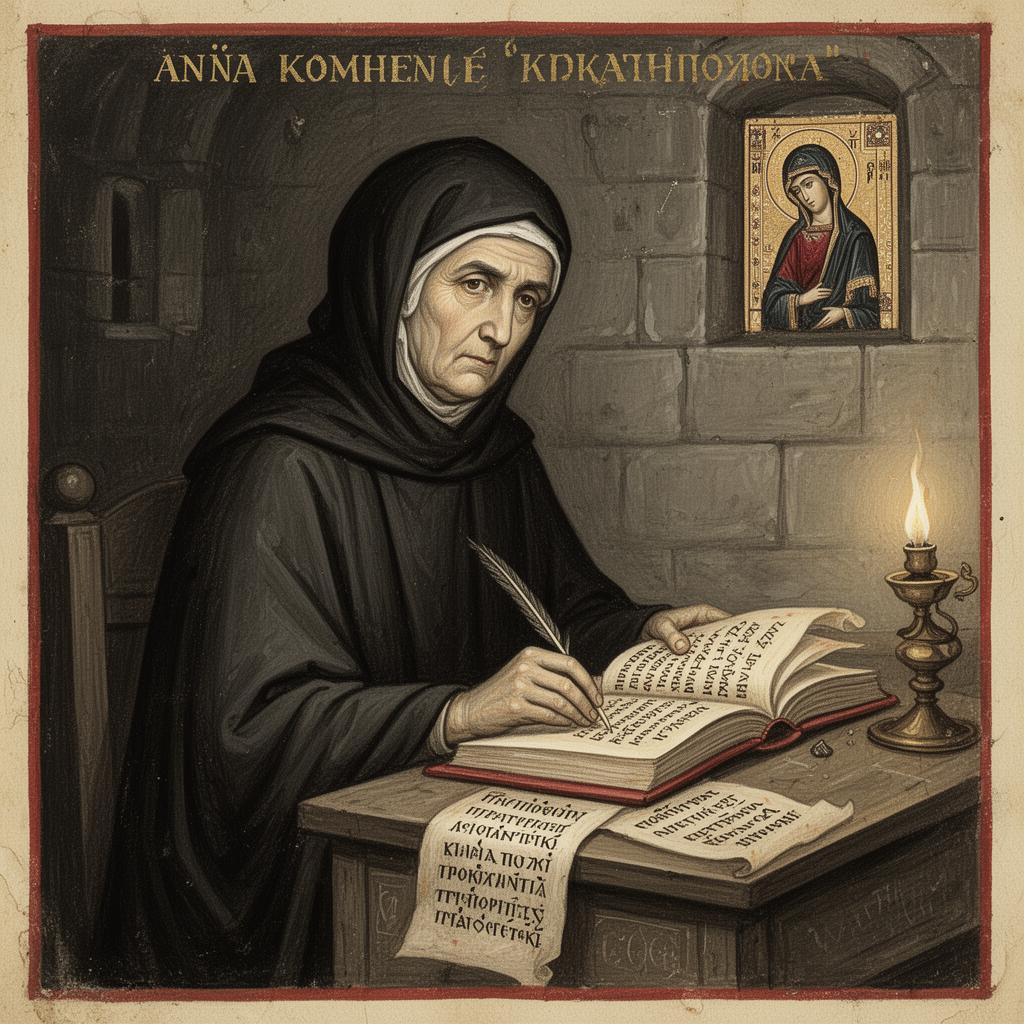
There is now a credits page on the chronicle, mirrored from the game itself, and the panel I most wanted to write is the one for Anna Komnene. This entry is the long version of it.
Anna was born in the porphyry chamber of the Great Palace on the first of December, 1083 — the eldest child of the emperor Alexios I Komnenos and the empress Eirene Doukaina, and therefore a porphyrogennete in the strictest sense the Romans used the word. She was betrothed in infancy to Constantine Doukas, the young co-emperor of her father's first years, and raised for a throne she never received. When Constantine died and her brother John was born, the succession swung away from her. After Alexios' death in 1118 she and her mother were implicated in the failed effort to put her husband, the kaisar Nikephoros Bryennios, on the throne in place of John II. She lived out the rest of her long life — she died around 1153, in her seventieth year — attached to the Kecharitomene, the convent her mother had founded on the western slope of the Fourth Hill.
It was there, in her widowhood, that she wrote the Alexiad: fifteen books of high Atticising Greek on the reign of her father, picking up where her husband's unfinished Hyle Historias left off. She covers the period from roughly 1069 to Alexios' death in 1118 — the First Crusade as seen from the eastern end of it, the long war with the Normans of Robert Guiscard, the Pecheneg disaster at Lebounion, the heresy trials of Basil the Bogomil, the Pisan and Genoese treaties, the slow knitting together of the Komnenian system that would hold the empire upright for another century.
Three things make the Alexiad permanently extraordinary. The first is simply that it exists at all. It is the only full-length narrative history we possess from a Byzantine woman, in a culture that did not as a rule admit women to the historian's chair, and one of the very small handful of book-length histories written by any woman anywhere in the medieval world. The second is the prose. Anna writes in a deliberately archaising Greek modelled on Thucydides and Homer — she calls the Latins barbaroi, refuses where she can to spell their alien names, and yet when she does spell them (Bohemond, Tancred, Raymond of Saint-Gilles) she gives us our sharpest contemporary close-ups of the leaders of the First Crusade. Her Bohemond in particular — tall, beautiful, terrifyingly intelligent — is one of the great character sketches in any medieval book. The third is the angle. She is, uniquely, an insider writing a half-hostile, half-fascinated account of the Crusade as it crossed her father's territory: a Roman princess watching armed pilgrims march past the walls of the City and trying to decide whether they were allies, vassals, or invaders. Almost everything else we know about the First Crusade is written from the western side. She is the eastern witness.
For scholarship she is indispensable. The last forty years of Byzantinist work — Jonathan Shepard, Paul Magdalino, Peter Frankopan, Leonora Neville above all — have steadily rehabilitated her from the older Gibbonian caricature of a vain and bitter princess complaining in purple. Neville's Anna Komnene: The Life and Work of a Medieval Historian (2016) is the book that finally puts her where she belongs: a serious classical scholar working inside a learned circle, patron of the Aristotelian commentator Michael of Ephesos, the centre of a philosophical theatron at the Kecharitomene. Frankopan's revised translation of the Alexiad for Penguin Classics (2009) is the one I keep on the desk. There is no telling the story of the late eleventh century without her, and no Crusade history that does not have to reckon with her.
For me she is something more particular. I was eleven, possibly twelve, and I had picked up a battered Penguin Alexiad in a charity shop for, I think, twenty pence. I had no idea what it was. I had been taught, in the casual way English children are taught these things, that the Roman Empire fell in 476 and that everything afterwards was the Dark Ages until Charlemagne. And here was a princess writing in the 1140s, in a Greek that still called itself Roman, describing crusaders crossing her father's frontier as though they were the foreigners and she was the centre of the world. Because, of course, she was. The shock of it — that the eastern empire had simply gone on, that there was a whole second half of Roman history that nobody had told me about — is the shock this entire game is built around. Without Anna I would not have gone looking for Choniates, for Psellos, for Skylitzes. Without her I would not have known there was a 1204 worth writing about. The door she held open is the door I walked through.
She matters to the world for a quieter reason as well. The Alexiad is one of the founding documents of women's intellectual history. For nine hundred years it has been the working proof that a learned woman in the medieval Mediterranean could write a major work of political history, in the highest register her culture knew, and have it survive. Every later defence of a woman's right to the historian's craft has, knowingly or not, been standing on her shoulders.
So the credits page on the chronicle has a panel for her, just as the game does. It reads, in the end, as a thank-you note nine hundred years late. Anna Komnene, porphyrogennete, kaisarissa, nun of the Kecharitomene, historian of the Romans — αἰωνία ἡ μνήμη, eternal be her memory.
Continue the chronicle
If you would like the next entry delivered, join the mailing list. One letter a month at most. Or write back — questions are answered in future entries at matthew@mrassociates.co.uk.