ΕΡΓΑΣΤΗΡΙΟΝ · From the Workshop
A Board Game on the Same Theme
14 June 2026 AD · Year 7534 of the Roman World
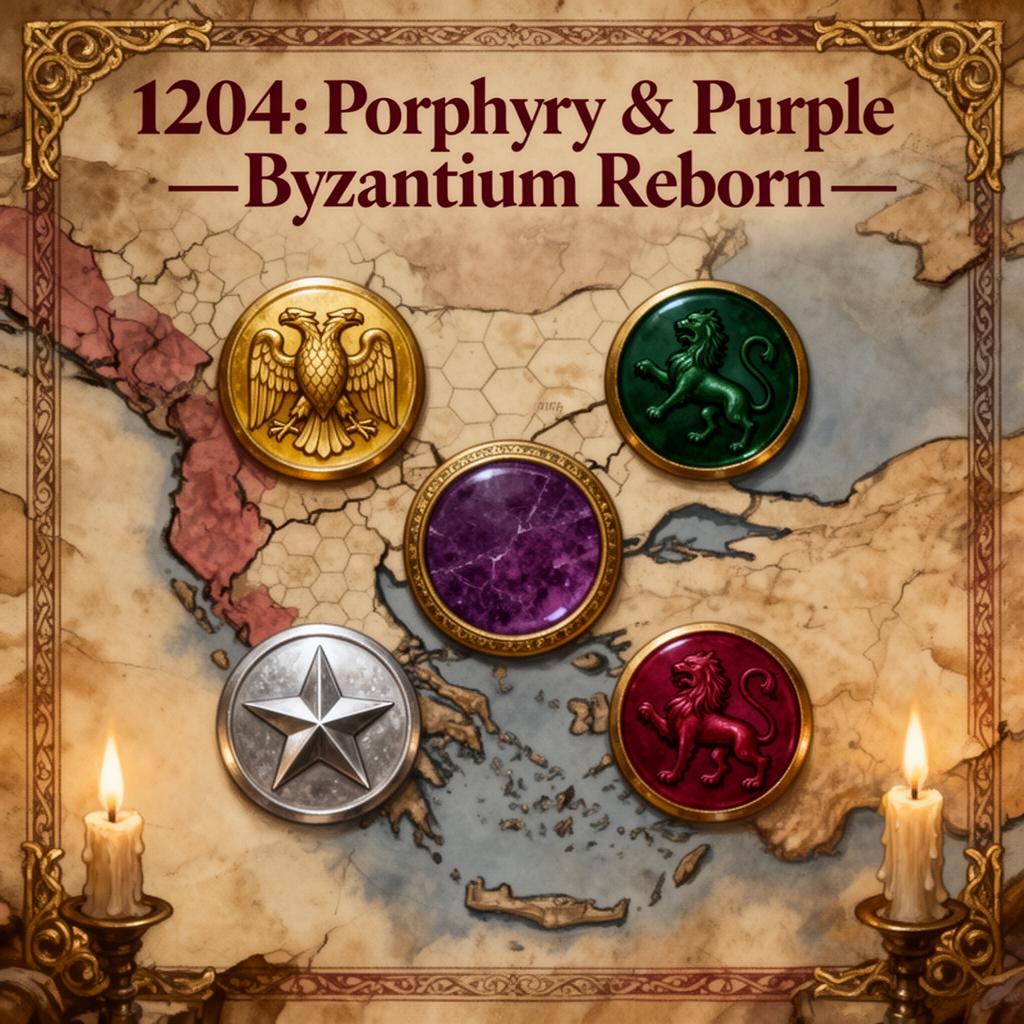
A short note this week, because the thing I want to point at is not yet a finished thing. The workshop has been quietly running a second project on exactly the same theme as the chronicle you are reading, but at a tabletop scale. It is called 1204: Porphyry & Purple — Byzantium Reborn, and it is a 1–4 player board game about the Greek successor powers in the years after the sack.
The roster is the obvious one, and the one this chronicle keeps returning to. Theodore Laskaris at Nicaea. The Despotate of Epirus under the Komnenos-Doukas line. The empire of Trebizond under the grandsons of Andronikos. And — the seat the digital game cannot really give you, because it has no single face — the loose fourth player: the independent Greek lands and lords who held their own walls without ever swearing to one of the three crowns. Philadelphia under Mankaphas. Rhodes under Leon Gabalas. The mountain archontes of the Peloponnese. The Maeander captains. The board game gives that constituency a seat at the table on purpose, because the period itself does, and because watching a player try to win as the un-empire is a different game from watching them try to win as Nicaea.
The pressing powers — Seljuks, Latins, Bulgars — are not a fourth, fifth, and sixth player. They are mechanics. They press in on schedules and on triggers; they take cities; they wreck campaigns; they can be bought, fought, married, or briefly used as a weapon against one of your Greek rivals. But no human ever sits behind their screen. That is a deliberate design choice that I think the period earns: the story of 1204–1261 is the story of four Greek answers to one Greek question, with the foreigners as weather. The board reflects that.
There are two games in the box. A one-hour-and-done sprint that resolves in a single sitting, for the table that wants to know who restores Rome before the wine runs out. And a longer campaign across multiple sessions, with carry-over state, that takes the same factions through the full arc to roughly the moment Michael VIII walks back through the Golden Gate. Both use the same map, the same factions, the same mechanic-driven pressers. The short game is the long game seen through a narrow window. The elegance — and the reason I am willing to talk about it before it ships — is in how little bookkeeping either version asks of the table. There is no spreadsheet under the cardboard. The system is the system, and the system fits on the player aids.
Like the chronicle, it is currently in closed playtesting. Unlike the chronicle, the playtest is virtual at the moment — small groups, screen-shared, the designer at the table. A public link will follow when the design is past the stage where every session changes the rulebook. Until then, the project sits on the [Other Works](/other-works) page with no clickable link, as a flag rather than a door.
If you have read the chronicle this far you are exactly the kind of reader the board game was written for. When the door opens, I will say so here.
Continue the chronicle
If you would like the next entry delivered, join the mailing list. One letter a month at most. Or write back — questions are answered in future entries at matthew@mrassociates.co.uk.