ΕΡΓΑΣΤΗΡΙΟΝ · From the Workshop
On Taking Limited Liberties with History
10 June 2026 AD · Year 7534 of the Roman World
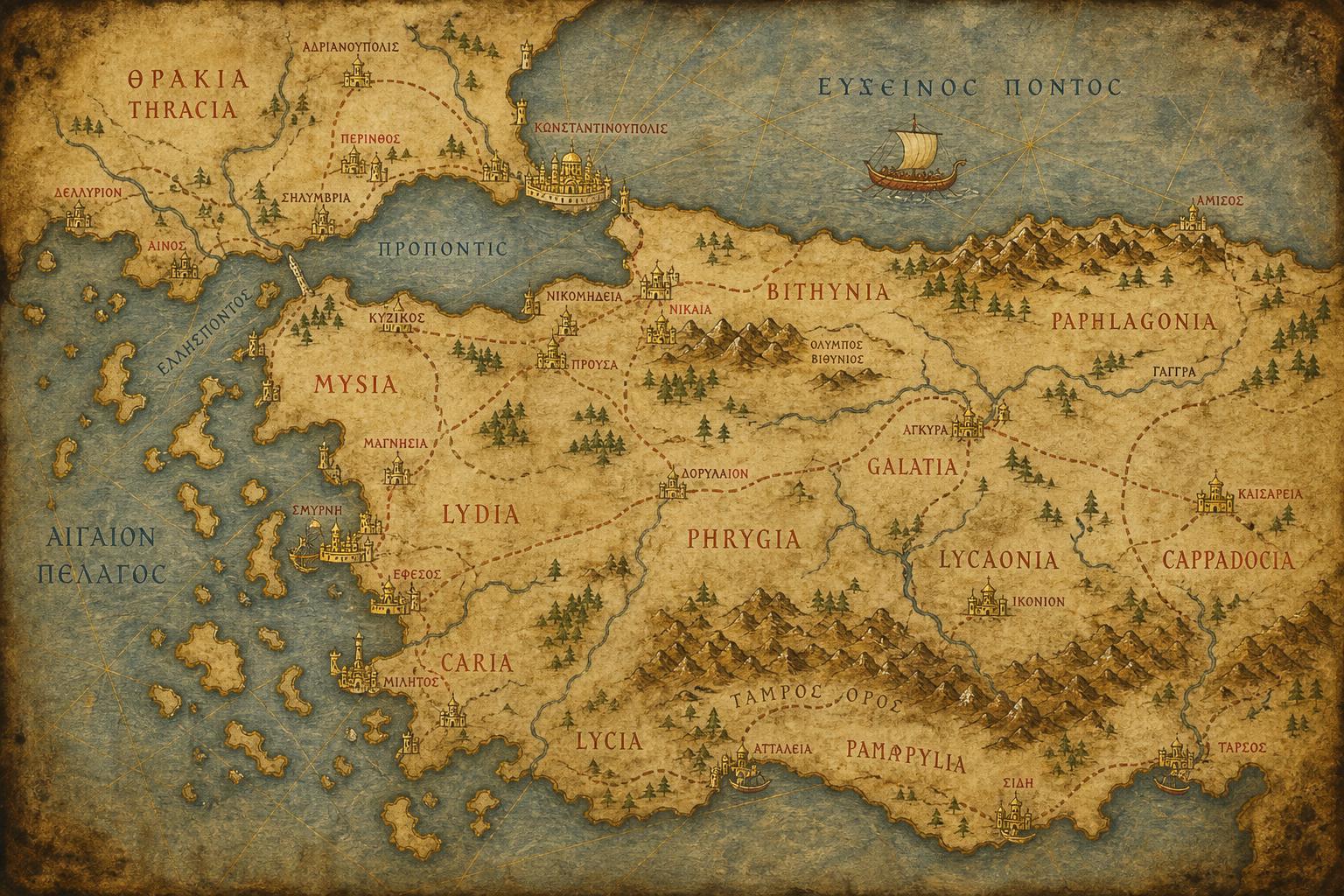
Every game set in a real moment of the past has to answer the same uncomfortable question: how much are you allowed to change? The honest answer, for this one, is — a little, deliberately, and always in one direction.
The rule of the workshop is that the spine of the period is not for editing. The Fourth Crusade sacks Constantinople in April 1204. Theodore Laskaris, son-in-law of Alexios III, escapes to Asia Minor. His brother Constantine has been acclaimed in Hagia Sophia the night before and slips out by the Asian shore. Theodore is crowned at Nicaea in 1208 with the Patriarch's hand on his head. He wins the Rhyndakos against his own defected brothers in 1211. None of those load-bearing facts will ever be quietly rearranged to make a system more elegant. If you read Choniates or Akropolites, the dates and the people you meet there are the dates and the people you meet here.
What the workshop does take liberties with is the texture between the load-bearing facts — and only ever in the service of the player feeling what a contemporary felt, rather than what a contemporary recorded. Theodore's escape from the burning City almost certainly took longer than a single panicked night; sources are vague and reconstructions vary. The prologue compresses it, because the prologue is about what it is to be hunted through your own capital, not about correctly accounting for four months of careful movement. A vignette like the Lake Askania dawn or the Sangarios bridge places a real Justinianic monument in front of you and invents the lake-fisherman Symeon, because Symeon stands in for a kind of person whose name nobody bothered to record but who was certainly there. The frame is true; the human in the frame is a portrait of a vanished type.
There are three liberties the workshop will not take. We will not invent a battle that did not happen, or move a real one to the wrong river, or give a real lord an oath he is recorded as refusing. We will not put words in Theodore's mouth that contradict what he is recorded as having said about a specific question — his refusal of union with Rome, for instance, is treated as character, not as a dial. And we will never make the Latins into stock villains; Innocent III's grief at the sack, Henry of Flanders's careful statecraft, and the genuine theological gulf between East and West are all on the page somewhere, because the period stops being interesting the moment one side becomes a uniform.
What this means in practice is small. A river-crossing is at the right ford. The Pythia Therma is on the actual road south from Nicaea. Pylai really is where the household ships came down. The Patriarch is addressed as His All-Holiness, not 'Holy Father', because that single word betrays whether the writer has been near a Greek liturgy. The shields are oval and bear saints' busts, the church beside the gate has a semantron and not a Latin campanile, and the bridge over the Sangarios has the right number of arches. The work of the workshop is mostly that — a thousand quiet calibrations, in service of a player ending the campaign with the feeling that they have been somewhere real.
If a future build ever does take a larger liberty, it will say so in this column. The unwritten contract of a historical game, as we understand it, is that the player should be able to trust the world. The liberties have to be admitted to be honest.
Continue the chronicle
If you would like the next entry delivered, join the mailing list. One letter a month at most. Or write back — questions are answered in future entries at matthew@mrassociates.co.uk.